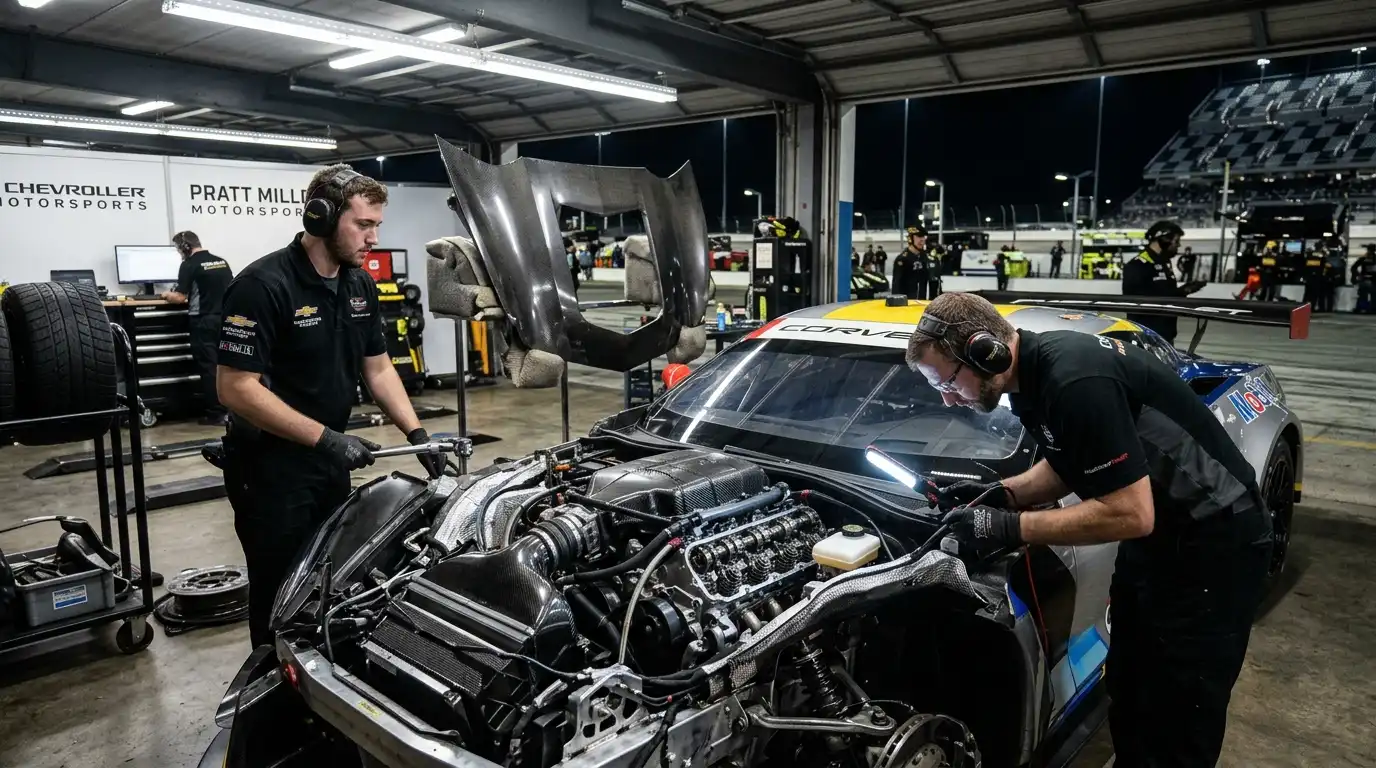
The transition from operating a highly insulated, full-factory racing program to executing a true global customer platform is one of the most treacherous paths a manufacturer can take in modern sports car racing. For decades, Chevrolet and their long-time technical partner, Pratt Miller Engineering, dominated the endurance racing landscape under the singular “Corvette Racing” banner. However, the introduction of the Corvette Z06 GT3.R marked a massive philosophical shift: for the first time, independent pro and amateur teams worldwide could buy, race, and maintain a factory-supported Corvette built straight out of New Hudson, Michigan.
While the car has achieved immense on-track milestones—highlighted beautifully by TF Sport capturing a spectacular LMGT3 class victory at the 2026 24 Hours of Le Mans—the reality of supporting multiple customer grids across IMSA, the FIA WEC, and GT World Challenge has heightened the stakes. As the 2026 season marches through its intensive summer stretch, a critical mechanical trend in the sports car paddock has emerged. A series of sudden, high-rpm valvetrain failures has triggered what insiders are calling a customer engine crisis. Now, Pratt Miller and GM Racing are racing against the clock to deploy a comprehensive engineering fix before catastrophic mechanical failures derail their customer teams’ championship aspirations.
The Anatomy of a High-RPM Crisis: The Flat-Plane Crank Problem
 To understand the root cause of the current engine anxiety floating through the customer paddock, one must look at the glorious, high-revving architecture powering the Z06 GT3.R. At the heart of the car sits the 5.5-liter, naturally aspirated LT6.R V8 engine. Directly derived from the production LT6 engine found in the road-going C8 Corvette Z06, this powerplant utilizes a dual overhead cam (DOHC) layout and a 180-degree, flat-plane crankshaft design.
Flat-plane crank V8s are prized in motorsports for their lightweight rotating assemblies, lightning-fast throttle response, and secondary scavenging characteristics that allow the engine to breathe efficiently all the way up to an aggressive 8,600 rpm redline. However, this configuration comes with an inherent, punishing trade-off: severe secondary high-frequency vibrations. Unlike traditional cross-plane V8s that use heavy counterweights to balance out forces, a flat-plane design deliberately sacrifices primary secondary balance for raw performance. These intense harmonic vibrations ripple through the engine block, placing immense, unnatural stress on every single component attached to it.
Reports from technical engineers within privateer operations running the Z06 GT3.R indicate that under sustained, maximum-load endurance racing conditions, a batch of faulty secondary harmonic dampeners has failed to properly neutralize these frequencies. Without proper damping, the high-frequency vibrations travel directly up into the valvetrain assembly. Over multi-hour stints, this harmonic distortion induces valve spring resonance, leading to sudden component fatigue, valve float, and ultimately, catastrophic internal top-end engine failure.
Pratt Miller’s Paddock-Wide Race Against Time
In the past, if a factory Corvette C8.R suffered an engine anomaly, the internal team could quietly pull the car into the garage, swap the motor, and analyze the telemetry behind closed doors. In a customer racing eco-system, however, there is nowhere to hide. When independent customer operations invest hundreds of thousands of dollars into an FIA-homologated platform, mechanical reliability isn’t just an engineering goal—it is a contractual obligation.
The logistical nightmare facing Pratt Miller and GM Motorsports Competition Engineering is vast. Unlike a single-series effort, the Corvette Z06 GT3.R is actively competing across separate continents simultaneously. Key operations include:
- The IMSA WeatherTech Contingent: Premium GTD Pro and GTD customer efforts requiring immediate technical oversight during intensive American sports car rounds.
- The Global WEC Campaign: Teams like TF Sport battling across international venues, meaning upgraded components must navigate strict international customs and tight paddock arrival windows.
- SRO GT World Challenge Teams: Privateer efforts that rely heavily on weekend-to-weekend reliability to stay alive in sprint and endurance championships without massive factory back-up budgets.
To counter the valvetrain issue, Pratt Miller has initiated an aggressive, paddock-wide component distribution and update program. Specialized technical representatives are being dispatched directly to customer garages equipped with redesigned, heavy-duty secondary harmonic dampeners and updated valvetrain telemetry sensors. The engineering goal is to swap out the suspect batches during routine pre-race tech inspections, preventing the dangerous harmonic buildup before the cars ever take the green flag.
Bridging the Gap: Track Verification vs. Road Car Reliability
 The timing of this customer engine crisis could not be more critical. Corvette has built its entire modern marketing identity around the concept of “Track Born, Street Ready.” The fact that the Z06 GT3.R race car shares its foundational aluminum chassis and core engine architecture with the road-going C8 Corvette Z06 is a major selling point for General Motors. When early production Z06 road cars occasionally faced warranty engine replacements, enthusiast forums took notice. Now that the race car is facing a parallel valvetrain hurdle under the spotlight of international sports car racing, the pressure to deliver a clean engineering resolution is immense.
However, this is exactly why sports car racing exists. The racetrack is the ultimate stress-testing laboratory. The extreme, sustained G-forces through corners like the Carousel at Road America or the relentless high-rpm demands down the Mulsanne Straight at Le Mans expose minor component tolerances that could take a consumer 100,000 miles to encounter on public roads. By identifying and resolving these harmonic dampener limits on the GT3.R under brutal racing conditions, Pratt Miller and GM are essentially stress-testing the future durability of the platform as a whole.
The Road Ahead for the Corvette GT3 Program
Despite the current engineering anxiety, the sky is far from falling for the Corvette Z06 GT3.R program. The vehicle has already proven it possesses race-winning pace, balance, and aerodynamic efficiency. Victories like the hard-fought IMSA GTD Pro triumph on the tight, unforgiving streets of the Detroit Sports Car Classic prove that when the car is firing on all cylinders, it can out-muscle the absolute best that Europe has to offer.
Every legendary racing platform has faced its baptism by fire. The true measure of a manufacturer’s motorsport legacy isn’t whether they encounter mechanical gremlins, but how fast and effectively they engineering a solution for the people paying to race their cars. If Pratt Miller can successfully execute this mid-season component rollout and stabilize the LT6.R’s valvetrain harmonics, the Corvette Z06 GT3.R will emerge from this summer crisis as an absolute bulletproof titan of global customer GT racing.